A New Standard for Equine Welfare: Why ISES has Adopted the IASP 2020 Definition of Pain
29.07.2026
For over twenty years, the International Society for Equitation Science (ISES) has championed evidence-based management and training methodologies to improve horse welfare. To maintain our commitment to scientific rigour we have formally updated our position statements to adopt the International Association for the Study of Pain (IASP) 2020 definition of pain:
The Definition: "
An unpleasant sensory and emotional experience associated with, or resembling that associated with, actual or potential tissue damage."
Why the change?
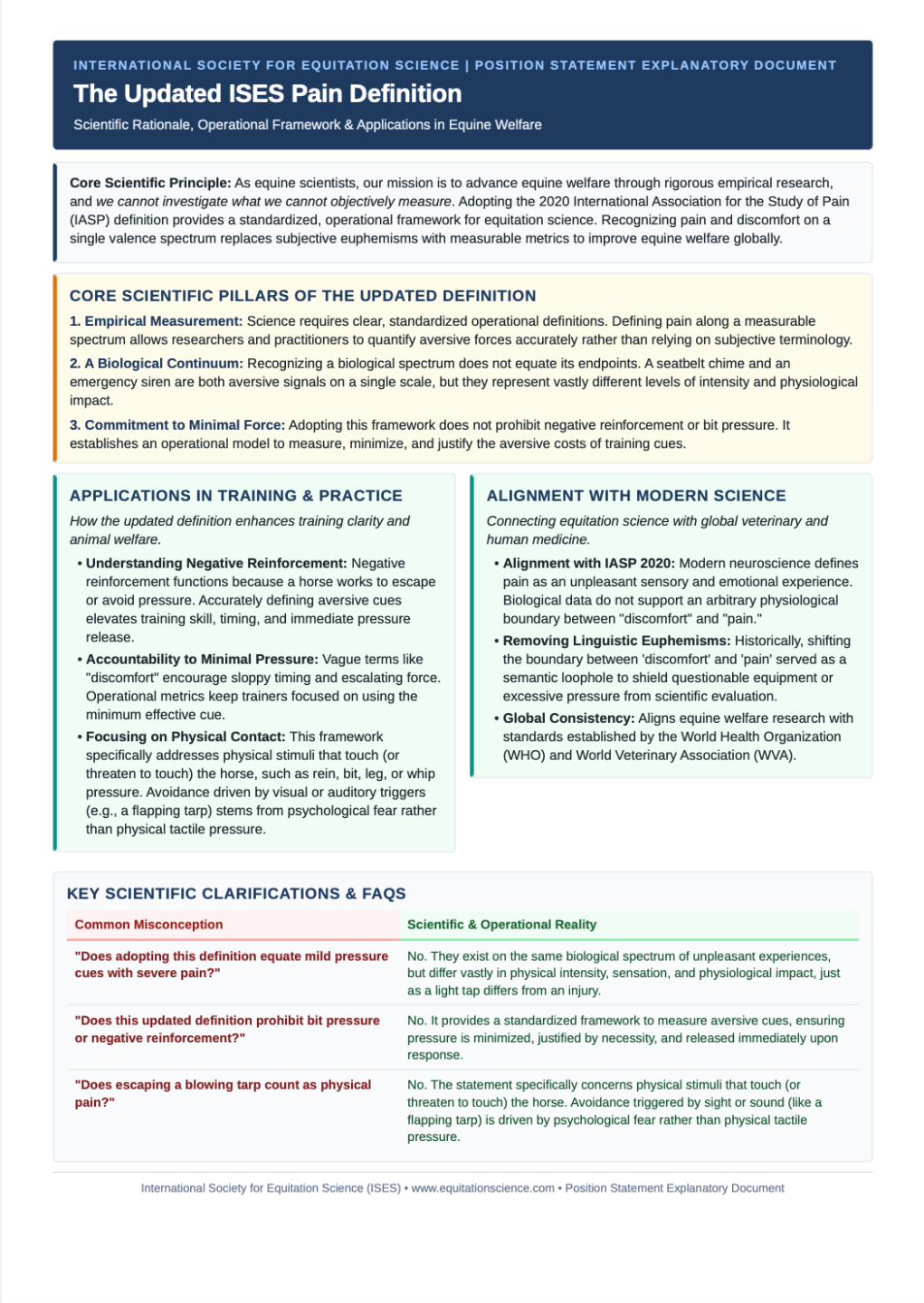
Previously, our guidelines, and much of the equestrian industry, made a distinction between "pain" and "discomfort". Modern pain science demonstrates that this arbitrary linguistic distinction is not based on biology. This explains why there is no validated means to identify where discomfort ends and pain begins. Under the IASP framework, any aversive stimulus that a horse works to avoid or escape causes an experience of pain, regardless of its intensity.
What this means for the equestrian community:
- Scientific accuracy: We are aligning with decades of research evidence from pain scientists and the World Health Organization and World Veterinary Association
- Listening to the horse: Since horses cannot speak, we must accept behavioural cues, such as conflict behaviours and escape and avoidance behaviours escape attempts, as legitimate evidence of a pain experience.
- Evidence-based training: This does not prohibit training; rather, it demands that we acknowledge the "pain cost" of the aversive stimuli used in training, work to minimize them and justify their continued use in training and competition.
By using clearer language, grounded in the latest quality science, we will move away from arbitrary terms that have provided a justification for the use of excessive pressure and restrictive equipment in equitation and handling which can’t be assessed scientifically .
The adoption of this clear and biologically based definition of pain to describe what horses experience when exposed to aversive stimuli will provide clarity to horse owners, researchers and regulatory bodies when assessing the impact of common and traditional practices. It will also provide a basis for minimising pain when we train, handle and interact with horses in equitation and management.
For more information please contact: [email protected]
Click the image below to download the Pain Explanatory Note.